
Nebraska Court Records After Arrest
After a Nebraska jail arrest, the custody record and the court record separate. The jail record shows booking status, facility, charge labels, bond if published, and possible release. The court record shows the case the prosecutor files, the court’s register of actions, hearings, financial entries, and dispositions. A booking charge can differ from the charge filed in court because the prosecutor may amend, reduce, add, or decline charges after review.
For current custody, use Nebraska inmate records. For booking photos, use Nebraska jail rosters and mugshots. For charges filed after arrest, use the court case systems described by the Nebraska Judicial Branch.
The Nebraska Judicial Branch case-information page explains statewide court record access through JUSTICE and SCCALES.
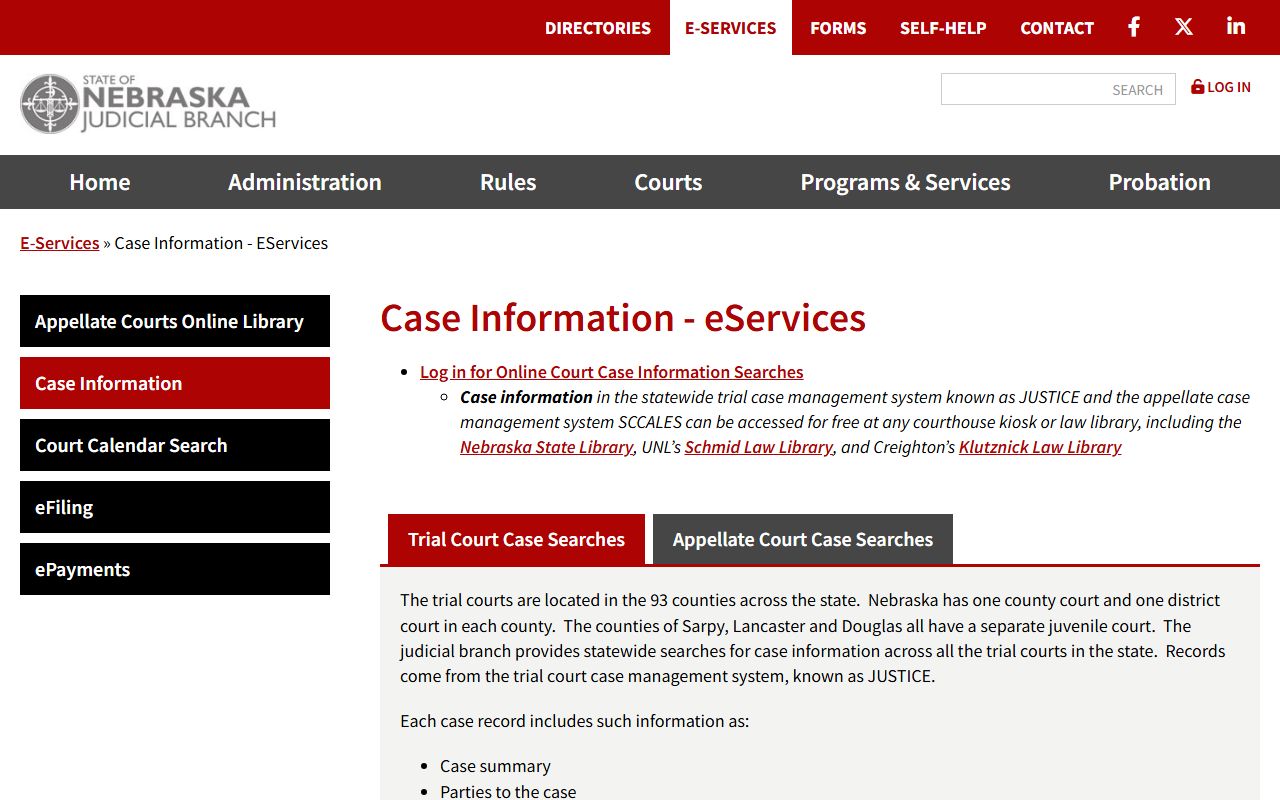
That page is the statewide anchor for case summaries, registers of actions, and public court record search.
Nebraska Trial Court Records
Nebraska trial courts operate in all 93 counties. Each county has county court and district court, and Sarpy, Lancaster, and Douglas also have separate juvenile courts. The Judicial Branch case-information page says statewide trial-court records come from JUSTICE, while appellate records come from SCCALES. Public case data can include case summary, parties, criminal offense information, financial information, the register of actions, judge notes if applicable, and electronic document images where available.
JUSTICE One-Time Court Case Search allows party-name searching and, according to the research, costs $17 for up to 30 records. Subscriber searches use account and per-case viewing costs. The Nebraska Multi-Court Case Calendar is a separate tool for hearing dates. It is not a custody locator.
| Record Need | System | Use |
|---|---|---|
| Trial-court case | JUSTICE | Criminal case summary, offense information, register of actions, and available images. |
| Appellate case | SCCALES | Appeals and higher-court case records. |
| Hearing date | Multi-Court Case Calendar | Upcoming court events, not custody status. |
Find Nebraska Court Records After Arrest
Search the court side after identifying the county and defendant name. A case may not appear instantly after booking because charging and court-entry timing vary. If the person was just arrested, the roster may update before the case search does. If a case appears but the jail roster does not, the person may have bonded out, transferred, or never entered that local jail.
- Identify the arresting county or the county court named on the booking record.
- Open Nebraska Judicial Branch case-information resources or the JUSTICE One-Time Court Case Search.
- Search by party name or case number when known.
- Open the case summary and review offense information, register of actions, financial entries, and next events.
- Use the court calendar for hearing dates, then confirm custody separately with the jail, NDCS, BOP, or ICE.
The JUSTICE One-Time Court Case Search is the statewide party-name search path cited in the research.
Use court search for case facts, not as proof of current jail or prison custody.
Charges After a Nebraska Arrest
Charges move through several labels. A complaint can begin a case. An information is a prosecutor-filed charging document often used in felony practice. An indictment is a grand-jury charging document. The research does not provide county-level charging variations for every Nebraska court, so the statewide page should define the documents without promising that every case uses all three.
| Document | Filed By | What It Means |
|---|---|---|
| Complaint | Officer or prosecutor | Initial allegation that can start a criminal case. |
| Information | Prosecutor | Formal charge filed by the prosecutor, common in felony practice. |
| Indictment | Grand jury | Formal accusation returned by a grand jury in qualifying cases. |
Nebraska Charge Status
A court record after arrest is not the same as a conviction record. Charges can remain pending, be amended, be reduced, be dismissed, or end in a plea or verdict. Jail rosters may keep the booking label while the court file shows a different final charge. That is why the court record matters after an arrest.
| Status | Plain Meaning |
|---|---|
| Pending | The charge is active and has not reached final disposition. |
| Amended | The prosecutor or court changed the charge wording, level, or count. |
| Reduced | The charge level or offense was lowered, often through plea or review. |
| Dismissed | The court record shows the charge was ended without conviction on that count. |
| Convicted | A plea or verdict resulted in conviction on that charge or amended charge. |
Bond After Nebraska Arrest
Bond and release information may appear on a jail roster, in court events, or both. A person can be booked, released, held on a no-bond warrant, held for another county, held for ICE, held for NDCS, or moved before a court search updates. Bond labels should be verified with the holding jail or court before payment or travel.
- Cash bond
- Money paid directly according to the court’s release order.
- Surety bond
- A bond posted through an approved bonding process where allowed.
- PR bond
- A personal recognizance release based on a promise to appear.
- Detainer
- A hold from another agency that may block release even after a local bond is addressed.
The Nebraska Multi-Court Case Calendar can help confirm hearing dates after an arrest, but it does not confirm custody or release.
Use calendar information with the jail or prison locator because a hearing can remain scheduled after the person leaves local custody.
Charges vs Convictions
An arrest is not a conviction. A charge is an accusation in the court record. A conviction is the result of a plea or verdict. Public users should not treat a roster charge, complaint, or pending case as proof that a person was found guilty. The final case disposition is the court record point that answers conviction status.
| Charge | Conviction | |
|---|---|---|
| Stage | Accusation after arrest or prosecutor filing. | Final result after plea or verdict. |
| Proof | Not proof of guilt. | Legal finding or admitted guilt. |
| Where found | Jail roster and court case may both show it. | Court disposition and sentencing record. |
Sealed and Restricted Records
The research supports cautious statewide language. Nebraska public records law has access rights and exceptions. Court and custody records may be restricted because of juvenile status, sealed court action, confidential investigative material, medical or mental-health material, security records, or inmate-file confidentiality. Neb. Rev. Stat. section 84-712.05 lists exceptions to public disclosure, and section 83-178 limits release of certain incarcerated-person files.
| Record State | Public Effect | Where to Verify |
|---|---|---|
| Open case | Public case data may be available through JUSTICE or the local court. | Nebraska Judicial Branch or county court clerk. |
| Restricted case | Some details may be hidden from public search. | Issuing court. |
| Confidential custody file | NDCS or jail may withhold internal categories. | Records custodian under Nebraska public-records law. |
Background Check Limits
Public case search is not a consumer background check. A court record can help a person understand charges, hearing dates, and case disposition, but employment, housing, credit, insurance, licensing, and similar decisions require legally compliant processes. Information can be stale, incomplete, or restricted.
Important: Do not use informal jail or court lookups for any Fair Credit Reporting Act covered decision.
Custody After Nebraska Court Records
A court record after arrest may point to several custody outcomes. If the case ends in a county sentence or pretrial hold, the county jail or receiving jail may remain the source. If the person receives a Nebraska prison sentence or a revocation commitment, NDCS becomes the search path. If a federal sentence follows, BOP becomes relevant after commitment. If an immigration detainer leads to transfer, ICE ODLS becomes the better custody source.
The NDCS incarceration-record search is the state prison follow-up after a Nebraska court commitment.
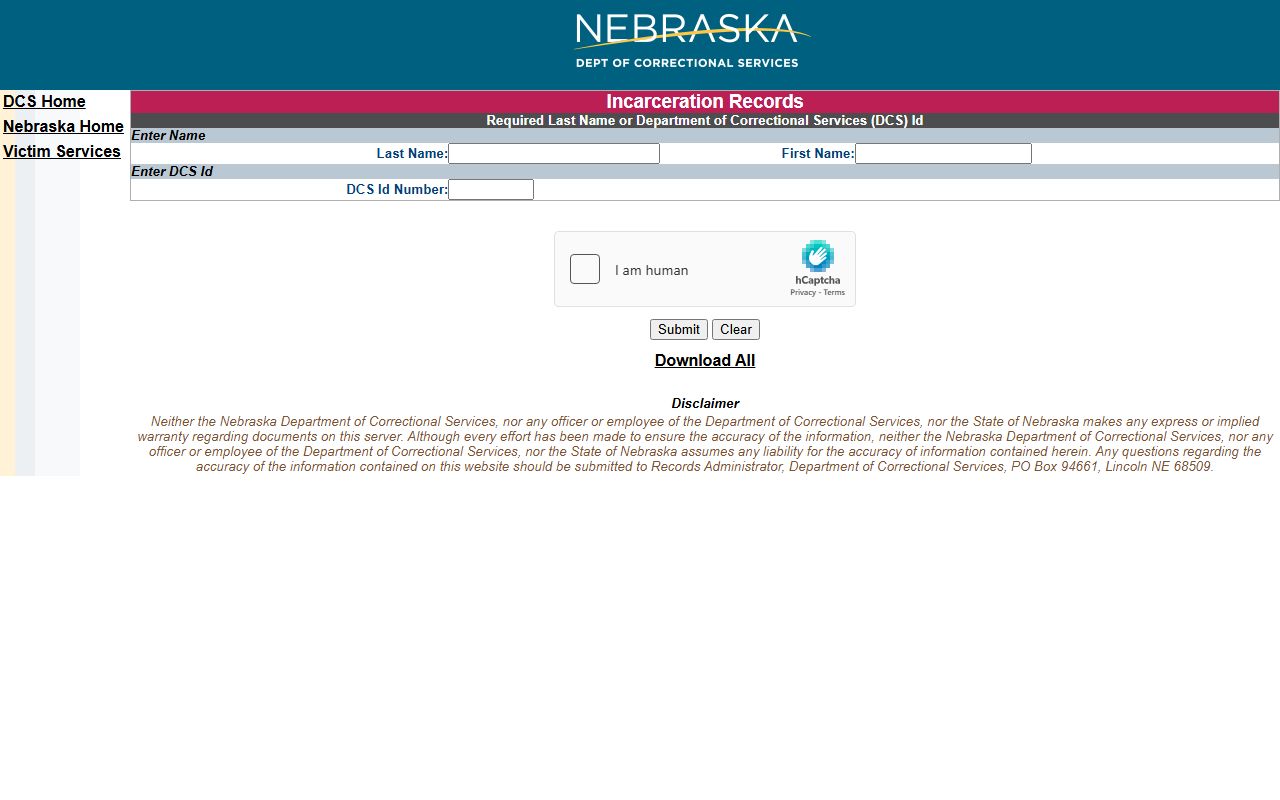
That follow-up search matters because a court sentence can move the custody record out of the county roster.
Public Record Search
Sponsored Results